







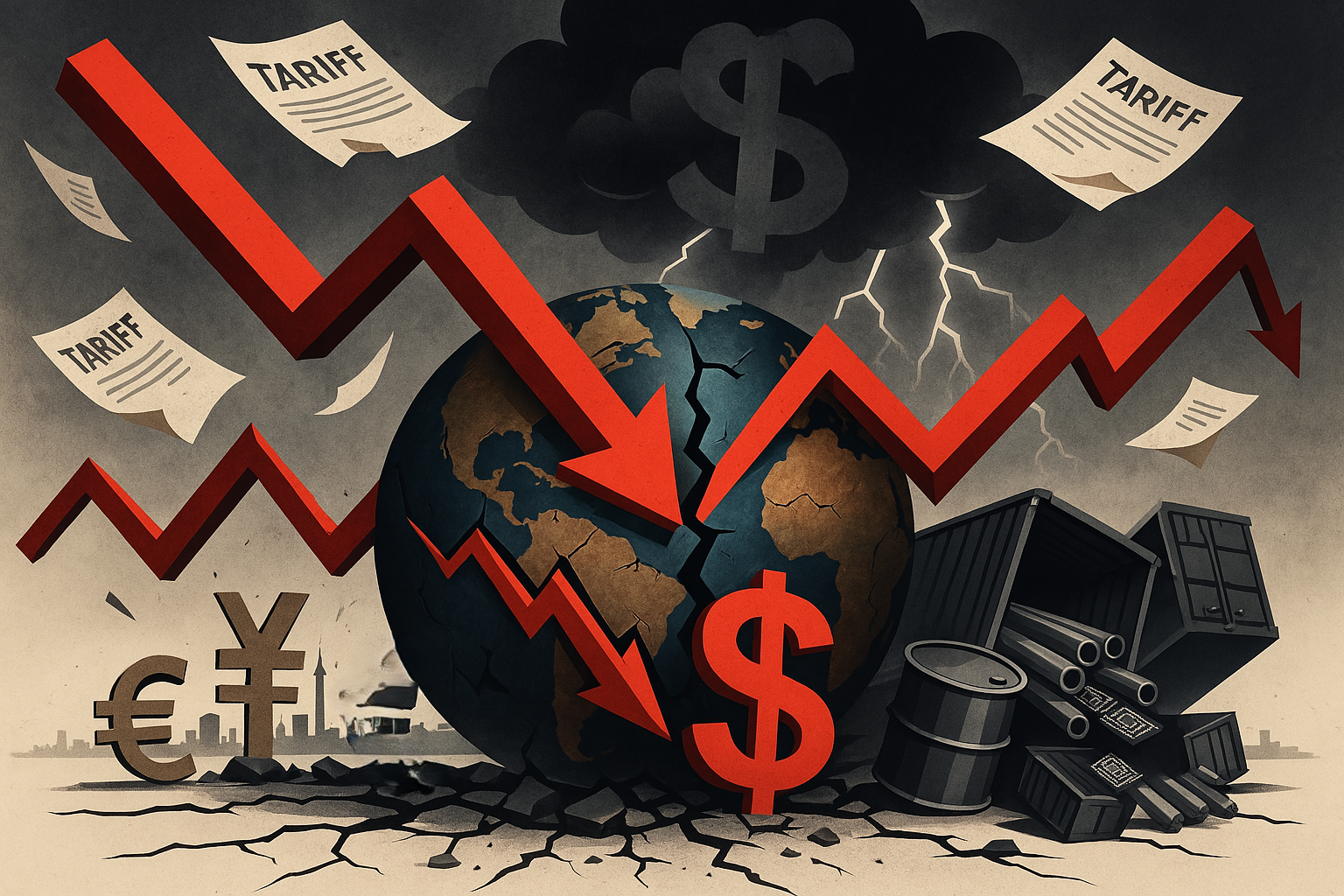
Wall Street endured another brutal session Monday as escalating tariff threats from President Donald Trump sent shockwaves through global markets. The Dow Jones Industrial Average posted its largest intraday point swing ever recorded, briefly rebounding on false hopes of a tariff pause before closing sharply lower. The S&P 500 nearly entered bear market territory before trimming losses, while the Nasdaq ends with a small gain thanks to a tech rally. Across the Atlantic and Pacific, selling was widespread as fears of a prolonged trade war took hold. With volatility soaring and economic risks mounting, investor sentiment remained deeply fragile.
Key Takeaways:
- Dow Posts Record Intraday Swing, Closes Lower for Third Day: The Dow Jones Industrial Average fell 349.26 points, or 0.91%, to finish at 37,965.60. The index plunged more than 1,700 points at its session low before rebounding briefly on unfounded tariff pause rumours, ultimately swinging 2,595 points intraday, the largest on record. Despite the short-lived rally, a White House denial of any delay in tariff implementation sent equities tumbling again. The Dow has now fallen over 1,200 points in three sessions.
- S&P 500 Briefly Enters Bear Market Before Trimming Losses: The S&P 500 shed 0.23% to close at 5,062.25 after falling 4.7% intraday. The index momentarily dropped into bear market territory before recovering some ground late in the session. Over the last three sessions, the benchmark has lost more than 10%, marking its worst such stretch since the pandemic crash in early 2020.
- Nasdaq Edges Higher as Tech Names Attract Bids: The Nasdaq Composite rose 0.10% to 15,603.26, lifted by strength in Nvidia and Palantir. At one point down more than 5%, the tech-heavy index clawed its way back as dip buyers focused on AI and semiconductor names. The modest gain contrasted with broader market losses and highlighted pockets of resilience among megacaps.
- European Markets Sink Again Amid Tariff Panic: The pan-European Stoxx 600 index closed down 4.54%, following a 6% plunge earlier in the session and capping a two-week drop of nearly 13%. The FTSE 100 tumbled 352.90 points, or 4.38%, to 7,702.08. France’s CAC 40 fell 4.78%, Germany’s DAX dropped 4.13%, and Italy’s FTSE MIB lost 5.18%. German exports jumped in February ahead of expected tariffs, but industrial production slid, exposing weakness in Europe’s largest economy. Market nerves remain high amid signs the EU is preparing retaliatory measures.
- Asia-Pacific Markets Crater as Trade War Sparks Broad-Based Sell-Off: Hong Kong’s Hang Seng Index plummeted 13.22% to 19,828.30, while the Hang Seng Tech Index plunged 17.16% to 4,401.51, both marking their worst one-day losses in years. China’s CSI 300 tumbled 7.05% to 3,589.44 amid investor reaction to Beijing’s retaliatory tariffs. Japan’s Nikkei 225 dropped 7.83% to an 18-month low, with futures trading halted after triggering circuit breakers. South Korea’s Kospi sank 5.57% while the Kosdaq fell 5.25%. Australia’s S&P/ASX 200 declined 4.23%, officially entering correction territory with an 11% drawdown from its February high. In India, the Nifty 50 lost 4.08%, and the BSE Sensex dropped 3.91%. Schroders estimates the US tariff regime will reduce American GDP by 0.9% and lead to losses of more than 0.5% of GDP in China and Vietnam, with the European Union and Japan also facing measurable impacts.
- Oil Slides to 2021 Lows as Recession Fears Mount: US crude dropped $1.29, or 2.08%, to settle at $60.70 per barrel, while Brent fell $1.37 to $64.21. Futures touched session lows of $58.95 and $62.51, respectively, both the weakest since 2021. Prices have now declined more than 12% over two weeks amid recession concerns and increased OPEC+ output. Goldman Sachs lowered its 2025 year-end target for WTI to $58, with further downside expected into 2026.
- Treasury Yields Rise Despite Mounting Growth Concerns: The 10-year Treasury yield climbed 18 basis points to 4.166%, while the 2-year rose to 3.753%. The move higher came even as investors ramped up expectations for Fed rate cuts, futures now price in five cuts for 2025, with a 50% chance of easing in May. The rise in yields signals lingering inflation fears driven by tariffs, even as growth expectations slide.
FX Today:

- EUR/USD Holds 1.0900 After Pullback from Multi-Month Highs: EUR/USD fell 0.24% to close at 1.0937, cooling off from recent highs above 1.1100. The pair remains above its 50-day SMA at 1.0633, 100-day at 1.0534, and 200-day at 1.0736, maintaining a bullish medium-term structure. Support is seen at 1.0900, with deeper levels near 1.0800 and the 200-day SMA at 1.0736. On the upside, resistance lies at 1.1000 and last week’s high near 1.1150. The outlook remains constructive unless the pair breaks below 1.0850, which could trigger deeper consolidation.
- GBP/USD Breaks Down Below 200-Day SMA After Rejection: GBP/USD dropped 1.17% to 1.2734 after failing to hold above the key 1.3200 resistance level. The pair closed back below its 200-day SMA at 1.2811 and 100-day SMA at 1.2630, raising concerns about bullish exhaustion. Immediate support is near the 50-day SMA at 1.2732, with further downside targets at 1.2600 and 1.2500. To resume an uptrend, bulls would need to reclaim 1.2850 and push toward 1.3000. For now, sentiment has shifted bearish, and rallies may face strong overhead resistance.
- USD/JPY Rebounds but Faces Strong Resistance: USD/JPY closed at 147.94, gaining 0.70% on the day after bouncing from lows just under 145.00. Despite the recovery, the pair remains below its 50-day SMA at 150.42, 100-day at 152.63, and 200-day at 151.27, indicating the broader downtrend is intact. The 148.00–148.50 area is now key resistance, sitting just below the falling 50-day average. A daily close above the 150.00–150.50 region would be needed to reverse the trend. On the downside, interim support is seen at 145.00, with a deeper floor near 144.00. The rebound may prove corrective unless momentum builds above the 150.00 level.
- EUR/GBP Breaks Out Above Range Highs and 200-Day SMA: EUR/GBP surged 1.07% to close at 0.8584, decisively clearing the 0.8500 resistance zone and the 200-day SMA at 0.8376. The rally ends a multi-month range between 0.8300 and 0.8450 and positions the pair above all major moving averages. The 50-day and 100-day SMAs at 0.8348 and 0.8334 now offer dynamic support. Immediate resistance lies near 0.8620–0.8650, with a potential extension toward 0.8700 on sustained strength. Support is seen at 0.8500 and further down near 0.8350. Momentum remains bullish as long as price holds above 0.8450.
- AUD/USD Crashes Below 0.6000 to Multi-Year Lows: AUD/USD plunged 0.90% to 0.5981, breaking decisively below the key 0.6000 psychological level. The pair has now lost over 5% in just five sessions and is trading beneath all major SMAs, the 50-day at 0.6285, 100-day at 0.6307, and 200-day at 0.6496. The breakdown opens the door to further losses toward the 0.5900 region, last seen in 2020. Resistance has built up at 0.6050 and 0.6200–0.6300 after repeated failed rallies. Unless price reclaims at least 0.6285, any bounce is likely to be sold into, with near-term momentum strongly favouring bears.
- Gold Breaks Below $3,000 as Correction Deepens: Gold fell 1.96% to close at $2,977.69, dropping below the critical $3,000 level as profit-taking intensified. The metal is now down three straight sessions from recent highs near $3,200. Despite the pullback, gold remains above its 50-day SMA at $2,942.58, with deeper support at $2,900 and $2,870. To regain bullish momentum, prices need to break back above $3,000 and then $3,050. If gold can clear $3,100, a retest of record highs remains on the table. The overall trend remains bullish unless the 50-day SMA is breached.
Market Movers:
- Apple Slides as China Tariff Fears Escalate: Shares of Apple fell 3.7% after President Trump vowed to impose a 50% tariff on Chinese goods unless Beijing reverses its 34% retaliatory hike. The iPhone maker has now lost nearly $640 billion in market value over the past three sessions.
- Tesla Declines on Supply Chain and Margin Concerns: Tesla dropped more than 2% as escalating tariffs raised fears over parts costs and production disruptions. Analysts noted the EV giant remains highly exposed to both Chinese suppliers and customers.
- Amazon Gains on Relative Domestic Insulation: Amazon.com rose more than 2% as investors favoured large-cap tech names with less international exposure. Analysts pointed to Amazon’s US-heavy revenue mix as a buffer against direct tariff impact.
- Broadcom Surges as Chipmakers Lead Rebound: Broadcom jumped over 5%, leading a rally in semiconductors after Monday’s tech rebound. Micron Technology, Lam Research, and KLA Corp each rose more than 4%, while Nvidia gained 3%, helping limit Nasdaq losses.
- Schlumberger Drops as Crude Hits New Lows: Schlumberger slumped more than 4%, while Occidental Petroleum, Chevron, and Hess each declined over 2% as WTI crude fell to a four-year low. Energy names remained under pressure amid rising recession fears and oversupply risks.
Markets remain on edge as President Trump’s aggressive tariff stance rattles investors and threatens to derail global growth. Monday’s historic volatility, highlighted by the Dow’s record 2,595-point swing, underscored the market’s sensitivity to trade headlines. While select tech stocks showed resilience, broad-based selling across sectors, regions, and asset classes reflects deepening fears of a self-inflicted recession. With volatility spiking and liquidity thinning, margin calls and forced selling may intensify if clarity doesn’t arrive soon. President Trump said if China doesn’t withdraw its 34% increase, he will impose additional 50% tariff on China. All eyes now turn to April 9, the date Trump’s new tariffs are scheduled to take effect, with global markets bracing for further disruption.