







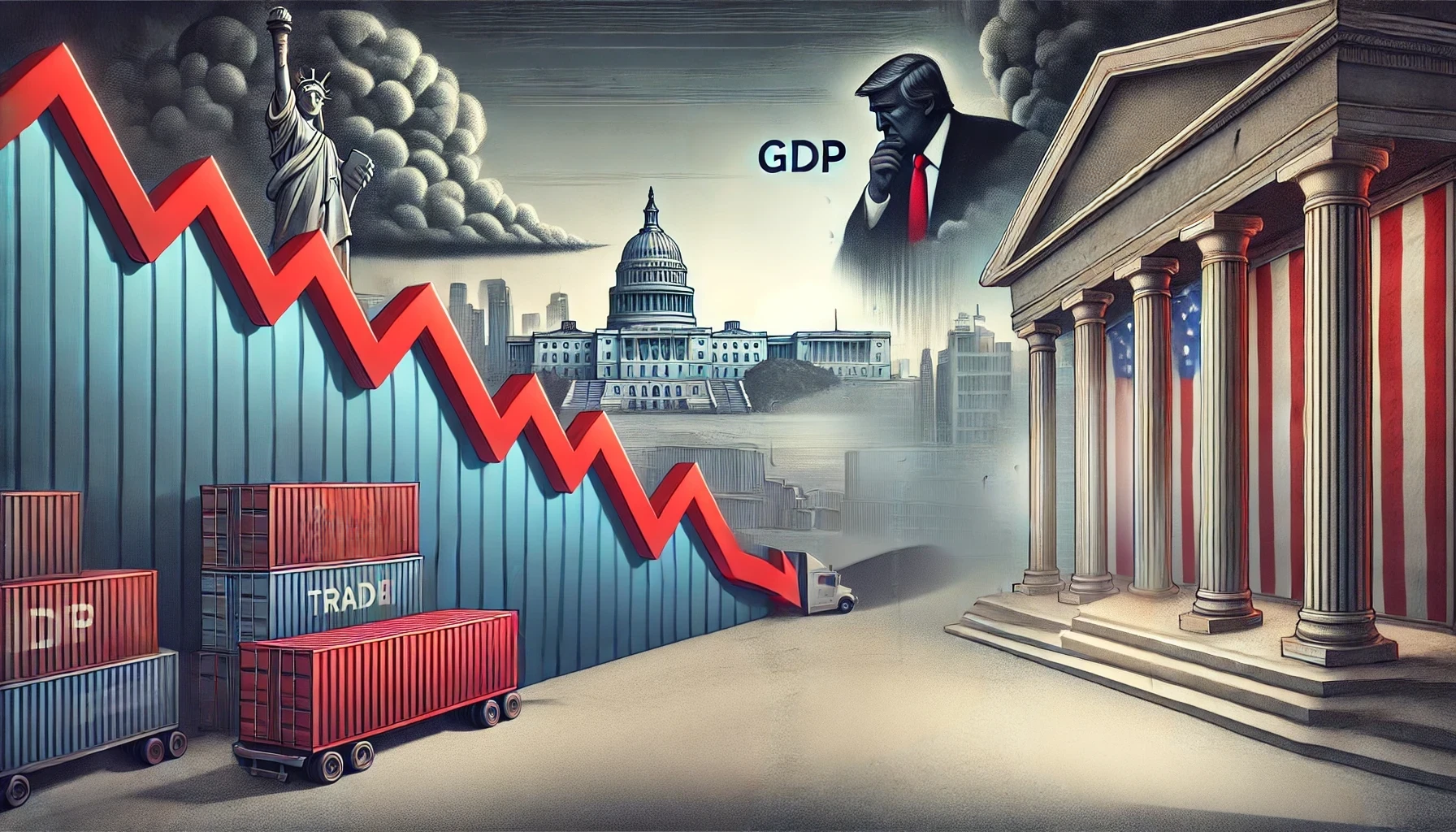
A surprise contraction in the US economy rattled markets on Wednesday, capping off a tumultuous April marked by policy whiplash and rising recession fears. The Dow climbed over 140 points by the close, while the S&P 500 eked out a modest gain and the Nasdaq slipped. Despite a late rebound that extended daily winning streaks, the S&P 500 still logged its third straight monthly loss. The latest GDP data showed a drop in the first quarter, triggering steep intraday losses before a recovery emerged. Investors remain wary as policy unpredictability continues to challenge the economic outlook.
Key Takeaways:
- Dow Extends Winning Streak despite Intraday Collapse: The Dow Jones Industrial Average rose 141.74 points, or 0.35%, to finish at 40,669.36 after recovering from a drop of more than 780 points. The blue-chip index notched its seventh straight daily gain as dip-buying offset early-session recession fears.
- S&P 500 Inches Higher but Records Third Monthly Loss: The S&P 500 gained 0.15% to close at 5,569.06. Despite a volatile session that saw the index fall nearly 2.3% intraday, it managed a modest daily advance. However, April still ended in the red, with the index down about 1% for the month, its third straight monthly decline.
- Nasdaq Dips as AI Momentum Fades: The Nasdaq Composite fell 0.09% to settle at 17,446.34, pressured by declines in AI-related names. NVIDIA slipped modestly, while Super Micro Computer plunged nearly 12% after weak preliminary results. The tech-heavy index remains under pressure following its recent surge.
- Europe Advances as Growth Beats Forecasts and Inflation Cools: European markets closed higher despite early weakness tied to the US GDP miss. The STOXX 600 rose 0.46% for its seventh straight daily gain, while the CAC 40 added 0.50% and Germany’s DAX climbed 0.3% to its highest since early April. The eurozone economy expanded 0.4% in Q1, exceeding expectations after stalling at the end of 2024. German GDP rose 0.2%, avoiding a technical recession, and inflation in the country eased to 2.2%, slightly above forecasts. Healthcare stocks outperformed while autos lagged on tariff worries. The FTSE 100 ended the month down 1.02%, and Italy’s FTSE MIB declined 0.71%.
- Asia Mixed as China PMI Contracts and Australian Inflation Surprises: Asia-Pacific markets delivered a mixed performance on Wednesday as investors assessed uneven economic signals across the region. Japan’s Nikkei 225 rose 0.57% to 36,045.38, with the broader Topix up 0.63%, as investors welcomed improved domestic sentiment and awaited the Bank of Japan’s policy decision. In South Korea, the KOSPI slipped 0.34% and the KOSDAQ lost 1.27%, as tech names struggled and sentiment was weighed by global trade tensions. Australia’s ASX 200 added 0.69% after Q1 inflation came in at 2.4% year-on-year, above the 2.3% forecast, adding pressure to rate expectations. Hong Kong’s Hang Seng rose 0.51%, rebounding after recent losses. Meanwhile, China’s CSI 300 dipped 0.12% as April’s manufacturing PMI fell to 49.0, its lowest since mid-2023, confirming a shift into contraction territory amid escalating US trade friction.
- Oil Suffers Biggest Monthly Drop since 2021: Brent crude fell $1.13, or 1.76%, to settle at $63.12 per barrel, while WTI sank $2.21, or 3.66%, to close at $58.22. For April, Brent tumbled over 15% and WTI plunged 18%, their largest monthly declines since November 2021. Prices slumped after Saudi Arabia signalled it would not pursue further output. A 2.7 million-barrel draw in US inventories did little to support sentiment as trade tensions weighed on demand outlooks.
- US Economy Contracts as Hiring Cools and Inflation Heats Up: First-quarter GDP contracted 0.3%, missing forecasts for a 0.4% gain and marking the first decline since early 2022. A 41.3% surge in imports ahead of new tariffs subtracted heavily from growth, while consumer spending slowed to 1.8% and government expenditures declined. ADP reported private payrolls rose just 62,000 in April, far below the 120,000 estimate, amid corporate caution linked to policy uncertainty. Core PCE inflation accelerated to 3.5% for the quarter, up from 2.4%, underscoring a challenging environment of slower growth and rising prices.
- Yields Steady as Traders Weigh Recession Risk against Inflation: The 10-year Treasury yield edged down to 4.156% while the 2-year yield slipped to 3.607%. The bond market reflected investor uncertainty as GDP data pointed to contraction while inflation data showed price pressures persisting. March PCE came in at 2.6% core, in line with forecasts, while headline PCE ticked up to 2.3%, slightly above expectations.
FX Today:

- EUR/USD Stalls near Multi-Month High as Momentum Eases: EUR/USD ended the session down 0.43% at 1.1337, slipping as bullish momentum faded near the 1.1400 zone. The pair remains above all key SMAs, 50-day at 1.0944, 100-day at 1.0667, and 200-day at 1.0776, showing the longer-term trend is intact. However, with repeated rejections above 1.1350 and diminishing buyer strength. Support lies at 1.1300 and 1.1200, both critical for preserving the uptrend. Traders appear unwilling to push higher without a fresh catalyst, leaving the euro vulnerable to deeper retracement. A breakout above 1.1400 would reassert control, but near-term tone is neutralising.
- GBP/USD Backs Off from Highs but Retains Uptrend Structure: GBP/USD dropped 0.58% to settle at 1.3329, pulling back from recent highs near 1.3450 after a strong April surge. Despite the retreat, the pair continues to trade above all major SMAs, with the 50-day at 1.2981, 100-day at 1.2724, and 200-day at 1.2845, all rising steadily. The area around 1.3300 now serves as immediate support, with further downside guarded by the 1.3200 level. Technical momentum has cooled, as reflected by shorter candle bodies and profit-taking behaviour. Still, the overall bias remains bullish unless the price falls decisively below 1.3200. A strong daily close above 1.3450 would likely trigger the next leg higher.
- USD/JPY Pushes Higher but Meets Resistance below 143.50: USD/JPY rose 0.46% to close at 142.95, extending its rebound from early April lows near 140.00. The short-term bounce has provided temporary relief for bulls, but the broader outlook remains clouded by a firmly bearish trend. The pair is still trading under the 50-day SMA at 147.02 and the 200-day SMA at 149.88, both of which slope downward and continue to cap upside potential. Momentum has slowed in recent sessions, with price caught in a sideways consolidation between 140.50 and 144.00. Bulls must reclaim the 50-day average to change the prevailing tone. For now, resistance remains firm near 143.50, and failure to break it may invite another push lower.
- AUD/USD Climbs as Traders React to US Weakness and Technical Setup: The Australian dollar gained 0.45% to close at 0.6411, supported by soft US GDP data and a rise in Fed rate cut expectations. The pair is now challenging its 200-day SMA at 0.6463 after a sharp rebound from lows near 0.5850 earlier this month. Both the 50-day and 100-day moving averages have turned higher, adding technical support at 0.6300 and 0.6280 respectively. Price has repeatedly tested the 0.6450–0.6460 zone but has yet to register a convincing breakout. If cleared, the next upside target sits near 0.6550. Until then, the pair may continue to coil within a narrowing range amid lingering trade uncertainty.
- Gold Pulls Back toward Support Zone but Bullish Bias Intact: Gold declined 0.67% to close at $3,294, slipping for a second session as it continues to retreat from its explosive mid-April rally peak. The move has brought price closer to the $3,250–$3,270 support area, which coincides with a recent swing low. Importantly, the metal remains well above its 50-day SMA ($3,074), 100-day ($2,901), and 200-day ($2,743), keeping the broader trend intact. Price action has become compressed, with buyers waiting to re-engage near stronger technical zones. A break above $3,330 could restore momentum, while a daily close below $3,250 would increase risk of a sharper drop toward $3,100.
Market Movers:
- Seagate Surges on Revenue Beat: Seagate Technology (STX) jumped over 11% after reporting first-quarter revenue of $2.16 billion, topping analyst estimates of $2.13 billion.
- Qorvo Rallies after Strong Earnings: Qorvo (QRVO) climbed more than 14% after the company posted fourth-quarter adjusted EPS of $1.42, well above the 99-cent consensus estimate.
- Trane Pops on Solid EPS Results: Trane Technologies (TT) gained over 8% after reporting Q1 adjusted EPS from continuing operations of $2.45, ahead of the $2.20 consensus.
- Energy Stocks Slide as Oil Drops Sharply: Oil-related names slumped after WTI crude fell more than 3%. APA Corp (APA) dropped over 4%, while Diamondback Energy (FANG), Halliburton (HAL), and ConocoPhillips (COP) lost more than 3%.
- Super Micro Tumbles on Weak Preliminary Results: Super Micro Computer (SMCI) plunged more than 12% after releasing disappointing preliminary fiscal Q3 net sales of $4.5–$4.6 billion.
- Starbucks Sinks on Disappointing Earnings and Tariff Concerns: Starbucks (SBUX) fell over 8% after reporting second-quarter adjusted EPS of $0.41, missing the $0.49 consensus.
- Werner Tanks after Downgrade: Werner Enterprises (WERN) dropped more than 10% after the stock was downgraded to underperform from in line, assigning a $21 price target.
Markets wrapped up a volatile April with a final dose of uncertainty as weak US GDP data and underwhelming private sector hiring figures revived fears of a slowdown. While the Dow and S&P 500 managed to extend their daily winning streaks, the broader tone remained cautious heading into May. Traders continue to wrestle with the implications of tariff policy swings, resilient inflation, and uneven global growth signals. As earnings season progresses and central banks prepare their next moves, volatility is likely to remain elevated. All eyes now turn to Friday’s nonfarm payrolls and updates from the Federal Reserve next week.