







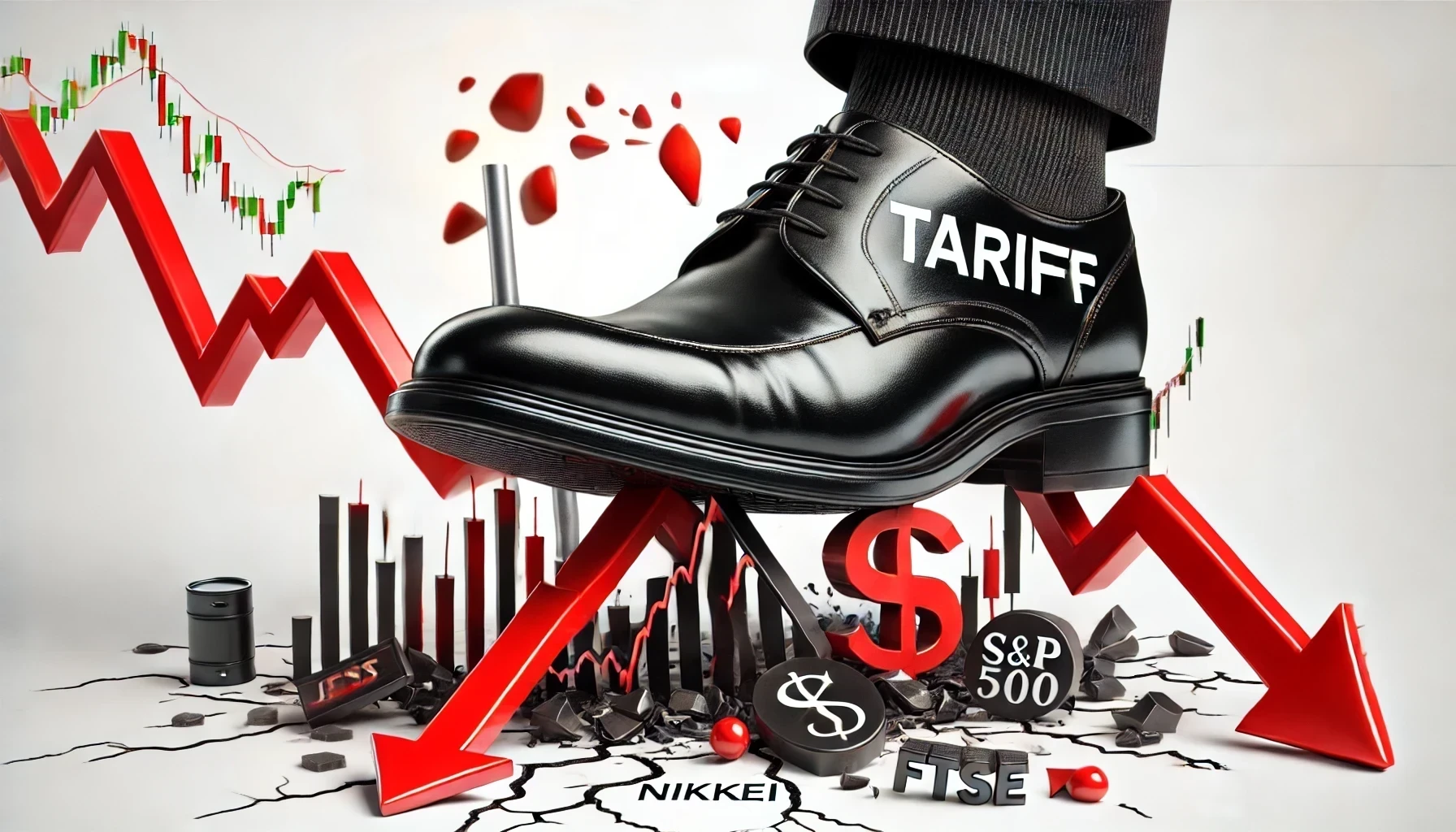
US stocks nosedived Thursday in a sweeping market collapse triggered by President Trump’s announcement of sweeping new tariffs, sparking fears of a global trade war and looming recession. The S&P 500, Dow Jones, and Nasdaq all suffered their worst single-day drops since the COVID-era selloff in 2020, as investors fled equities for safer assets. Multinational and tech stocks led the decline, while bond yields plunged amid risk aversion. With tariffs now set to rise sharply on goods from over 180 countries, markets are bracing for more volatility in the weeks ahead.
Key Takeaways:
- Dow Suffers Nearly 1,700-Point Meltdown on Tariff Shock: The Dow Jones Industrial Average plunged 1,679.39 points, or 3.98%, to close at 40,545.93, marking its worst session since June 2020. Heavy losses in multinational names like Nike and Apple accelerated the selloff, as markets digested the implications of higher import costs and retaliatory trade actions.
- S&P 500 Tumbles Nearly 5% as Correction Deepens: The S&P 500 sank 4.84% to 5,396.52, falling back into correction territory and posting its largest one-day drop since the pandemic era. Over 400 stocks in the index closed lower. The index now sits roughly 12% below its all-time high from February, with traders eyeing technical support in the 5,200–5,400 range.
- Nasdaq Posts Worst Decline Since 2020 as Tech Unravels: The Nasdaq Composite collapsed 5.97% to close at 16,550.61, its steepest daily drop since March 2020. Mega-cap tech names were hammered in a broad-based rout, with Nvidia down nearly 8% and Tesla losing more than 5%.
- European Stocks Slide as Supply Chains, Autos and Banks Take Hit: European equities closed sharply lower as Trump’s sweeping tariffs raised the threat of a global trade war and hammered export-heavy sectors. The Stoxx 600 index dropped 2.7%, while Germany’s DAX lost 2.96%, France’s CAC 40 tumbled 3.3%, and Italy’s FTSE MIB fell 3.60%. The UK’s FTSE 100 declined 1.55% to 8,474.74, as retailers and automakers sank. Auto stocks slid 3.9% after Trump’s 25% auto tariff took effect, while banks fell 5.6%. Meanwhile, Eurozone March composite PMI rose slightly to 50.9, and services PMI came in at 51.0. However, France’s services sector remained in contraction at 47.9, and February PPI missed forecasts at +0.2% month-over-month.
- Asia-Pacific Markets Sink as Tariffs Threaten Regional Export Engines: Asia-Pacific markets fell sharply on Thursday after Trump’s surprise tariff escalation targeted over 180 countries. Japan’s Nikkei 225 dropped 2.77% to 34,735.93, while the broader Topix index lost 3.08%. South Korea’s Kospi declined 0.76%, and the Kosdaq dipped 0.2%. Hong Kong’s Hang Seng slid 1.7%, and mainland China’s CSI 300 slipped 0.59%. India’s Nifty 50 fell 0.31%, while the BSE Sensex dropped 0.35%. Australia’s ASX 200 declined 0.94% despite March’s S&P Global PMI rising slightly to 51.6 from 51.3. Markets reacted to steep new tariff rates on goods from China (54%), India (26%), South Korea (25%), and Australia (10%).
- 10-Year Treasury Yield Plunges to Five-Month Low on Safe-Haven Flows: The 10-year US Treasury yield fell 15 basis points to 4.045%, hitting its lowest level since October as investors fled equities for safety. The move followed Trump’s tariff escalation, which has raised fears of a global slowdown. The 2-year yield fell even more sharply, dropping 20 basis points to 3.704%.
- Oil Prices Plunge on Tariffs and OPEC+ Supply Surge: Crude oil tumbled more than 6% on Thursday, suffering its steepest drop since 2022, as global demand fears collided with a surprise supply boost from OPEC+. Brent settled at $70.14 per barrel, down 6.42%, while WTI finished at $66.95, down 6.64%. The sharp decline came a day after Trump’s sweeping tariffs raised fears of a global economic slowdown, just as OPEC+ advanced its production plan to return 411,000 barrels per day to the market in May.
- ISM Services Index Misses Forecasts as Hiring Weakens Sharply: US service sector activity slowed more than expected in March, with the ISM services index falling to 50.8, below forecasts of 52.9. The employment component tumbled to 46.2, indicating contraction in hiring, while new export orders also weakened. Although jobless claims fell to 219,000 last week, the ISM data suggests a softer tone heading into Friday’s labour report. Traders remain concerned that slowing demand may compound the economic drag from tariffs.
FX Today:

- EUR/USD Breaks Above 1.1000 as Dollar Weakens Sharply: EUR/USD surged 1.55% to close at 1.1017, its highest finish since July 2024, as the US dollar tumbled following Trump’s tariff announcement. The pair broke cleanly through key resistance at the 1.1000 level, lifted by safe-haven flows into the euro and technical momentum. All major moving averages are now sloping higher, with the 50-day at 1.0614 and 200-day at 1.0733 supporting the bullish outlook. Continued strength could push the pair toward the 1.1100–1.1150 zone if risk sentiment remains fragile.
- GBP/USD Near 1.3100 as Bulls Regain Control: GBP/USD climbed 0.56% to settle at 1.3082, breaking decisively above the psychologically important 1.3000 level. The pair has been consolidating beneath this barrier for several weeks, and Thursday’s breakout confirms the resumption of its February rally. With the 50-day, 100-day, and 200-day moving averages all turning upward, the technical bias remains bullish. Momentum could carry the pair toward resistance at 1.3150 and 1.3200, provided it holds above recent breakout levels.
- USD/JPY Crashes Below 147 as Bearish Reversal Accelerates: USD/JPY plunged 1.90% to close at 146.38, posting its steepest one-day decline since February. The pair broke below several key technical levels, including the 200-day SMA at 151.40, as traders fled to the yen amid rising market volatility. With the 50-day SMA turning downward and the 100-day SMA flattening, downside pressure has intensified. If the decline continues, the next supports lie at 145.00 and 143.50.
- USD/CAD Drops to 17-Week Low as Loonie Surges: The Canadian dollar rallied strongly, sending USD/CAD down 0.99% to 1.4091, its lowest level since December 2024. The Greenback sold off across the board following the tariff announcement, helping the Loonie break below the 50-day SMA at 1.4323 and the 100-day SMA at 1.4276. Price action is now testing the 200-day SMA at 1.3983. A close below that level could signal a deeper correction, despite longer-term bullish structure still in place.
- Gold Retreats from Record Highs Amid Broad Market Turmoil: Gold eased 1.10% to settle at $3,103.84, pulling back after hitting a new all-time high of $3,167.74 earlier in the session. The decline was driven by broader market selloffs and short-term profit-taking, but the metal remains in a strong uptrend. Key support sits at the $3,100 level, while a rebound above $3,140 could reignite bullish momentum. Moving averages remain supportive, with the 50-day at $2,932.27 and the 200-day at $2,666.39.
Market Movers:
- RH Collapses Over 40% on Weak Earnings and Housing Market Fears: Luxury furniture retailer RH crashed 40.1% after missing earnings expectations and offering downbeat guidance. CEO Gary Friedman warned the company is operating in the “worst housing market in almost 50 years,” spooking investors.
- Lululemon Drops on Vietnam Tariff Exposure: Shares of Lululemon plunged 9.6% after Trump’s reciprocal tariff plan imposed a 46% levy on goods from Vietnam, where the company sources nearly 90% of its products.
- Deckers Outdoor Plummets on Supply Chain Concerns: The Ugg maker tumbled 14.5% after details emerged showing the company has extensive exposure to Vietnam and China, both hit by steep new tariffs.
- Nike Sinks as Tariffs Threaten Core Manufacturing Hubs: Nike shares tumbled 14.4% as investors reacted to the risk posed by 54% and 46% tariffs on China and Vietnam, respectively — countries where Nike manufactures roughly half of its footwear. The stock was among the worst performers in the Dow.
- Five Below and Dollar Tree Crushed by Import Tariffs: Shares of Five Below and Dollar Tree dropped 27.8% and 13.3%, respectively, after Trump’s announcement. As major sellers of imported goods, both retailers face rising cost pressures.
- Big Tech Stocks Tumble as Tariffs Rattle Growth Outlook: Megacap tech names sold off aggressively amid investor fears over higher input costs and reduced global demand. Apple and Amazon both fell more than 9%, Alphabet lost 4%, while Tesla declined 5.5% as sentiment turned sharply risk-off.
- Wayfair Tumbles on Southeast Asia Tariff Risks: Wayfair shares were hammered after Trump’s tariff plan targeted key sourcing nations such as Vietnam, Thailand, and Cambodia. With substantial exposure to those countries, analysts fear Wayfair may struggle to offset rising import costs.
- Semiconductor Stocks Slide Despite Exemption: Despite being exempt from new levies, semiconductor stocks were swept up in the market downturn. Nvidia dropped 7.8%, AMD fell 8.9%, Broadcom declined 10.5%, and Qualcomm slumped 9.5%.
Markets suffered their worst day in years as Trump’s aggressive tariff push reignited fears of a global trade war and economic downturn. Equities plunged across sectors, with multinational and tech names leading the selloff, while bond yields and oil prices also tumbled. Weak US services data and sliding PMI readings in Europe added to the uncertainty, underscoring the fragility of global growth. With tariffs set to take effect in days, investors are bracing for continued volatility and potential downside in the weeks ahead.