







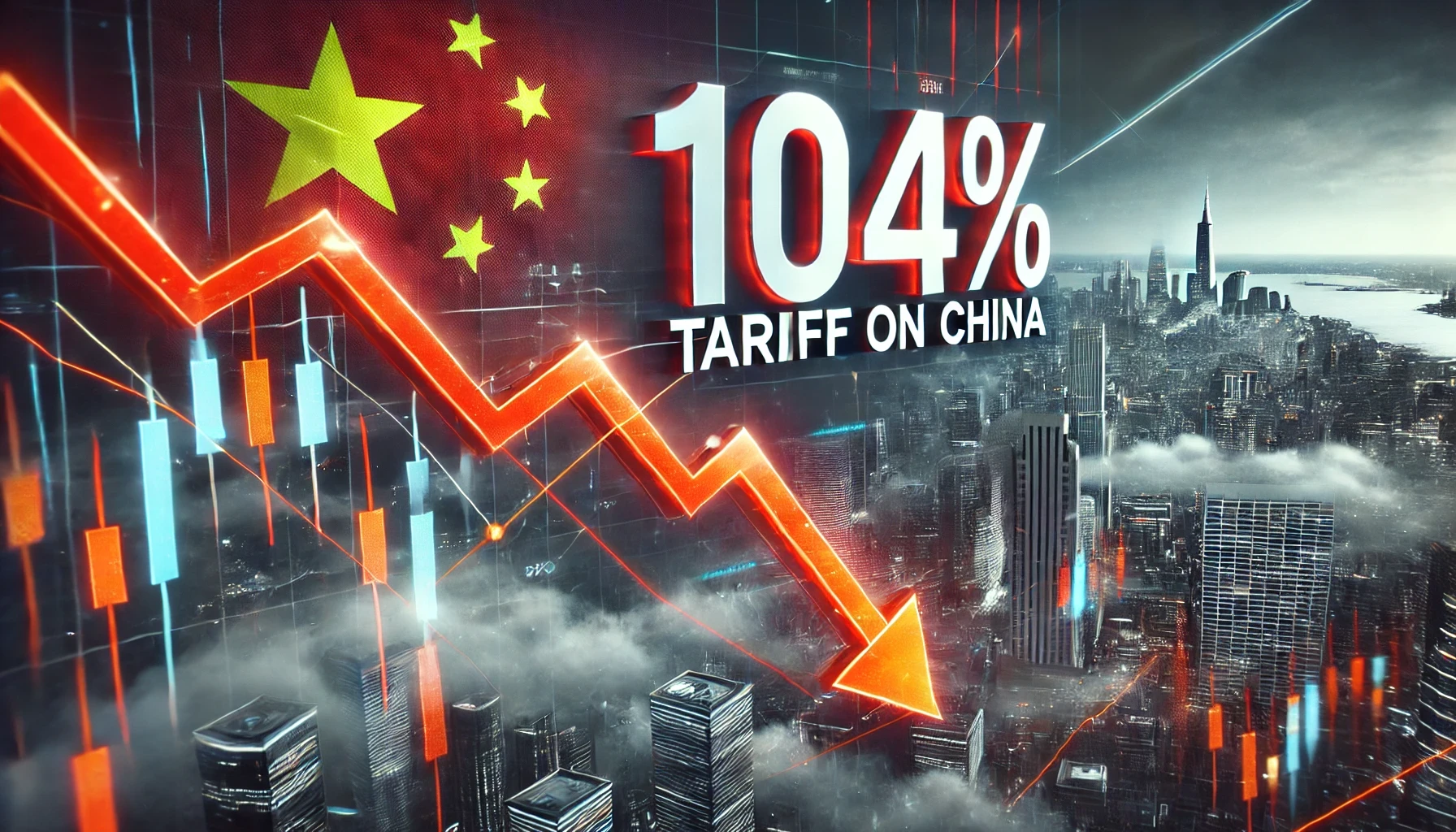
US stocks fell sharply on Tuesday as a fleeting relief rally gave way to renewed selling ahead of a key China tariff deadline. The Dow Jones Industrial Average dropped more than 300 points, while the S&P 500 and Nasdaq posted deeper losses, driven by fresh concerns over the economic fallout of President Trump’s aggressive trade strategy. Investors had initially welcomed signs of global tariff negotiations, but sentiment quickly reversed after the White House confirmed a cumulative 104% tariff on Chinese goods would take effect just after midnight. Apple led the declines, with its shares tumbling nearly 5% as cost pressures mount. The selloff caps a volatile stretch for equities, with major indices suffering steep multi-day losses amid heightened policy uncertainty.
Key Takeaways:
- Dow Tumbles More Than 300 Points as Tariff Jitters Return: The Dow Jones Industrial Average fell 320.01 points, or 0.84%, to close at 37,645.59, marking its fourth straight day of losses. The index has now shed more than 4,500 points since the latest wave of tariff concerns began. Apple led the decline, dropping nearly 5% Tuesday and over 23% in just four sessions. Despite an early rally of nearly 4%, the Dow reversed lower as trade fears deepened.
- S&P 500 Closes Below 5,000 as Bear Market Nears: The S&P 500 slid 1.57% to end at 4,982.77, falling below the psychologically important 5,000 mark for the first time since April 2024. The index is now down nearly 19% from its February all-time high, inching closer to official bear market territory. Over the last four sessions alone, the S&P has dropped more than 12%.
- Nasdaq Sinks Over 2% in Tech-Led Selloff: The Nasdaq Composite declined 2.15% to finish at 15,267.91 after rising as much as 4.5% earlier in the day. The index has now fallen more than 13% over the past four sessions, led lower by tech heavyweights like Apple, which is facing higher input costs from the new tariffs.
- European Stocks Rebound Sharply After Steep Losses: European equity markets surged Tuesday, breaking a four-day losing streak triggered by escalating global tariff tensions. The pan-European Stoxx 600 index jumped 2.72% to close at 486.9. The FTSE 100 rose 2.71% to 7,910.53, France’s CAC 40 climbed 2.50%, Germany’s DAX gained 2.48%, and Italy’s FTSE MIB advanced 2.44%. The bounce came as investors responded to comments by European Commission President Ursula von der Leyen, who reiterated the EU’s willingness to negotiate a “zero-for-zero” tariff deal.
- Asia-Pacific Markets Rebound but Remain Deeply Volatile: Asian stocks bounced back on Tuesday after a brutal Monday session triggered by fears of a renewed global trade war. Japan’s Nikkei 225 soared 6.03% to 33,012.58 and the Topix index gained 6.26%, recovering from their worst day in over a year. Australia’s ASX 200 rose 2.27%. South Korea’s Kospi inched up 0.26%, while the Kosdaq added 1.1%. Hong Kong’s Hang Seng Index rebounded 1.51% after plunging more than 13% on Monday, its worst single-day decline since 1997. The tech-heavy Hang Seng Tech Index jumped 4.49%. Mainland China’s CSI 300 rose 1.71% to 3,650.76. Meanwhile, Indonesia’s Jakarta Composite dropped 7.87% following a circuit-breaker pause, and Vietnam’s benchmark fell 6.48%. Thailand’s SET Index also extended losses, closing at its lowest level since March 2020.
- Oil Crashes Below $60 on Trade War Fears: US crude oil fell $2.50, or 4.17%, to settle at $58.17 per barrel, the lowest level since April 2021. Brent crude slid $2.76, or 4.27%, to $61.45. Prices are now down more than 15% since last Wednesday, when Trump announced sweeping tariffs. Fears of a global trade war and rising recession odds continue to batter sentiment. OPEC+ supply increases have only added to the bearish tone. Analysts warn of further downside unless trade clarity emerges.
- 10-Year Treasury Yield Climbs on Weak Auction and Tariff Worries: The 10-year US Treasury yield rose 12 basis points to 4.285% following a weak $58 billion auction of 3-year notes. The 2-year yield dipped 2 basis points to 3.715%. Yields have moved sharply higher since the weekend amid growing inflation expectations tied to tariffs. The 10-year had traded below 3.9% early Monday but surged to 4.14% by day’s end, the biggest one-day jump in a year.
FX Today:

- EUR/USD Holds Above 1.0900 Support as Momentum Slows: EUR/USD rose 0.44% to close at 1.0953, remaining in a short-term consolidation phase after a 450-pip rally from 1.0650 to 1.1100 in late March. The pair failed to reclaim last week’s high of 1.1104, with overhead resistance at 1.1000–1.1120 capping gains for now. Still, it holds above key support at 1.0900, previously resistance in January and February. Technically, the pair retains a bullish structure with price above the 50-day SMA at 1.0642, the 100-day at 1.0538, and the 200-day at 1.0737. Bulls need a decisive break above 1.1000 to resume the uptrend, while a drop below 1.0880 could signal deeper retracement toward the 1.0640 zone.
- GBP/USD Struggles Near 200-Day SMA After Intraday Rebound: GBP/USD gained 0.39% to settle at 1.2773, bouncing from intraday lows but still facing stiff resistance. The pair briefly touched the 200-day SMA at 1.2811 but failed to close above it, signalling hesitation near the long-term average. The 50-day SMA at 1.2739 was narrowly reclaimed by session-end, while the 100-day SMA at 1.2632 forms part of a dense technical cluster just below. On the downside, the 1.2700 level remains initial support, and a break below could open the door to 1.2630 or even 1.2500. To reassert bullish control, GBP/USD would need to clear 1.2820–1.2850 and close firmly above the 200-day SMA.
- USD/CHF Bounces But Remains Below Key Moving Averages: USD/CHF climbed 0.28% to close at 0.8981, rebounding modestly from Monday’s low of 0.8946. The pair has dropped nearly 180 pips from its April 2 high at 0.9124 and continues to trade below its 50-day SMA at 0.9024. The 100-day and 200-day SMAs at 0.8897 and 0.8885 respectively offer deeper support levels. Short-term resistance lies at 0.9025–0.9040, and a break above that could target the 0.9100–0.9120 region. Conversely, a drop below 0.8940 may trigger fresh selling pressure and bring 0.8900 and the 100-day average into view.
- AUD/USD Extends Breakdown to Fresh Multi-Year Lows: AUD/USD dropped 0.37% to close at 0.5961, hitting its lowest level since November 2022. The pair has fallen nearly 330 pips in five sessions and now trades well below its 50-day SMA at 0.6279, the 100-day at 0.6302, and the 200-day at 0.6492. The technical setup is firmly bearish, with momentum favouring a continuation toward 0.5900 and potentially 0.5850. Minor intraday support lies at 0.5940, but this level lacks historical strength. Bulls would need to reclaim 0.6050 and then the 0.6150 zone to meaningfully challenge the downtrend.
- Gold Rebounds Above $3,000 as Buyers Step in at Key Support: Gold rallied 1.41% to close at $3,019.42, reclaiming the $3,000 mark after a sharp pullback earlier this week. The metal dipped to a low of $2,951.66 before bouncing off its 50-day SMA at $2,951.58. Longer-term moving averages remain supportive, with the 100-day at $2,812.93 and the 200-day at $2,683.60 trending upward. Resistance sits at $3,050 and $3,100, while a break above $3,170 could open a path toward the psychological $3,200 level. On the downside, key support remains at $2,950–$2,980, and a close below this zone could shift momentum back to the bears.
Market Movers:
- Apple Drops as Tariff Fallout Mounts: Shares of Apple fell 4.95% after being up more than 4% earlier in the day, bringing its four-day slide to nearly 23% as investors braced for sharply higher input costs from new China tariffs.
- ON Semiconductor Slides on Chip Sector Weakness: ON dropped over 8%, leading a broad selloff in semiconductor stocks as renewed trade tensions sparked demand concerns. Peers like AMD, Intel, and Microchip also posted losses of over 6%.
- Humana Surges on Medicare Advantage Payment Increase: Humana rallied more than 10% to lead S&P 500 gainers after CMS finalised a 5.06% increase in 2026 Medicare Advantage payments. CVS and UnitedHealth rose more than 5% each.
- PDD Holdings Tumbles on Trump Tariff Threat: Shares of PDD fell more than 6% after President Trump threatened to raise tariffs on Chinese goods by 50% unless Beijing rolls back its 34% levy on US imports.
- Tesla Extends Decline Amid Tech Weakness: Tesla slid over 4%, part of a broader pullback in high-growth tech stocks. The company has now lost more than 12% over the past week as investor sentiment sours.
- Amazon Sinks as Mega Caps Retreat: Amazon dropped more than 2% as part of a broad retreat in the “Magnificent Seven” stocks. Nvidia, Meta, and Alphabet also slipped over 1% each, while Microsoft closed down 0.92%.
- RPM International Falls on Weak Q3 Sales: RPM shares dropped over 9% after reporting third-quarter net sales of $1.48 billion, missing analyst expectations of $1.51 billion. The miss weighed on industrial names.
Markets ended Tuesday on a sharply risk-off note, with major US indices tumbling as tariff worries overshadowed earlier optimism. A fleeting rally fuelled by diplomatic gestures faded after the White House confirmed a sweeping 104% tariff on Chinese goods. Tech and chip stocks led the declines, while oil plunged below $60 per barrel and Treasury yields spiked on weak auction demand. Investors remain wary of escalating trade tensions and their potential impact on global growth. All eyes now turn to upcoming inflation data and corporate earnings later this week, as traders seek clarity in an increasingly volatile macro landscape.